

There has never been a better moment to turn your sketchbooks, paintings, and prints into something that actually pays. The market for independent art has grown dramatically across the UK, with platforms, social media channels, and digital tools making it entirely possible for a self-taught watercolourist in Leeds or a printmaker in Bristol to reach buyers across the globe. But knowing how to sell art online takes more than uploading a few photos and hoping for the best. It takes a plan, a personality, and a little bit of patience.
Pick the Right Platform for Your Style
Not all platforms are built for all artists. Etsy remains the most popular starting point for UK makers, with a built-in audience already searching for handmade and original work. It suits illustrators, printmakers, and anyone selling physical originals or limited edition prints. Society6 and Redbubble handle printing and fulfilment for you, which is brilliant if you want to sell art online without managing stock. For higher-end original work, Saatchi Art has a UK presence and attracts serious collectors willing to spend proper money.
If you want total control over branding, a Shopify or Big Cartel shop gives you that freedom, though you will need to drive your own traffic. Many artists run a combination: an Etsy shop for discoverability, and a personal site for the serious buyer experience. According to the UK government’s creative industries guidance, the creative sector contributes over £100 billion annually to the UK economy, which tells you buyers are absolutely out there. You just need to find yours.
Photography That Actually Does Your Work Justice
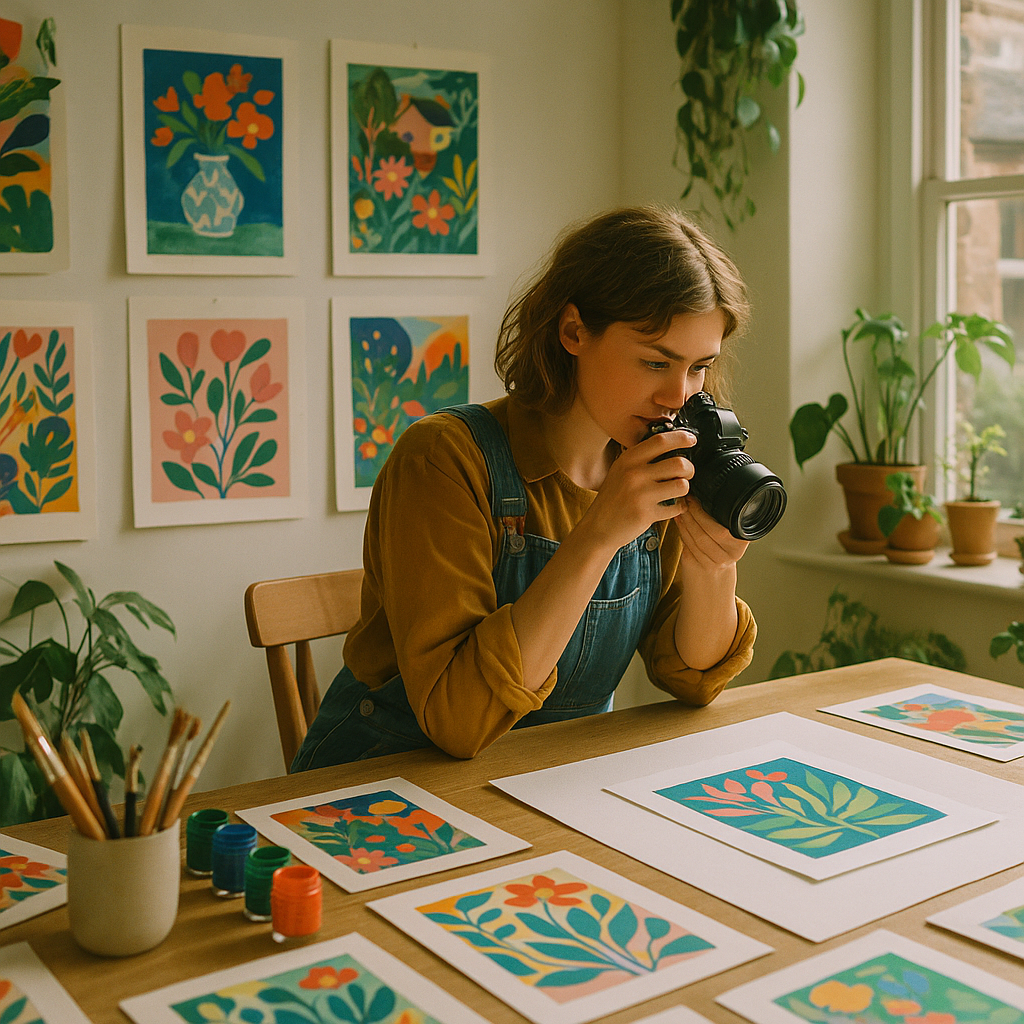
Your artwork might be stunning in real life but look flat and lifeless in a photograph. This is one of the most common mistakes new sellers make. Natural light is your best friend. Shoot near a large north-facing window on an overcast day to get soft, even light without harsh shadows or colour casts. Avoid flash photography entirely.
Use a decent mobile with the camera set to its highest resolution, and keep the artwork on a clean, neutral background. For paintings, a slight angle can replicate the way a viewer looks at work on a wall. For prints and paper-based work, shoot flat. Edit gently in Lightroom or even the free Snapseed app to correct white balance and boost clarity, but never over-saturate. Buyers need to trust what they see on screen. Take at least one lifestyle shot too, which shows the piece hanging in a real room. This single image change can double conversion rates.
Pricing Your Art Without Underselling Yourself
Pricing is emotional for most artists. The instinct is to go low to get that first sale, but chronically underpriced work sends the wrong signal. A tried and tested formula for original pieces: (hourly rate x hours) + materials + a percentage for platform fees and postage. For prints, calculate your cost of production and mark up by at least 3x to leave room for discounts and margins.
Research comparable artists on Etsy at a similar career stage. If your prints are going for £8 and theirs are £22, you probably are not too expensive. You are probably too cheap. Raise prices gradually and give loyal followers fair warning. Most buyers who love your work will not blink.
Building a Colourful Brand People Actually Remember
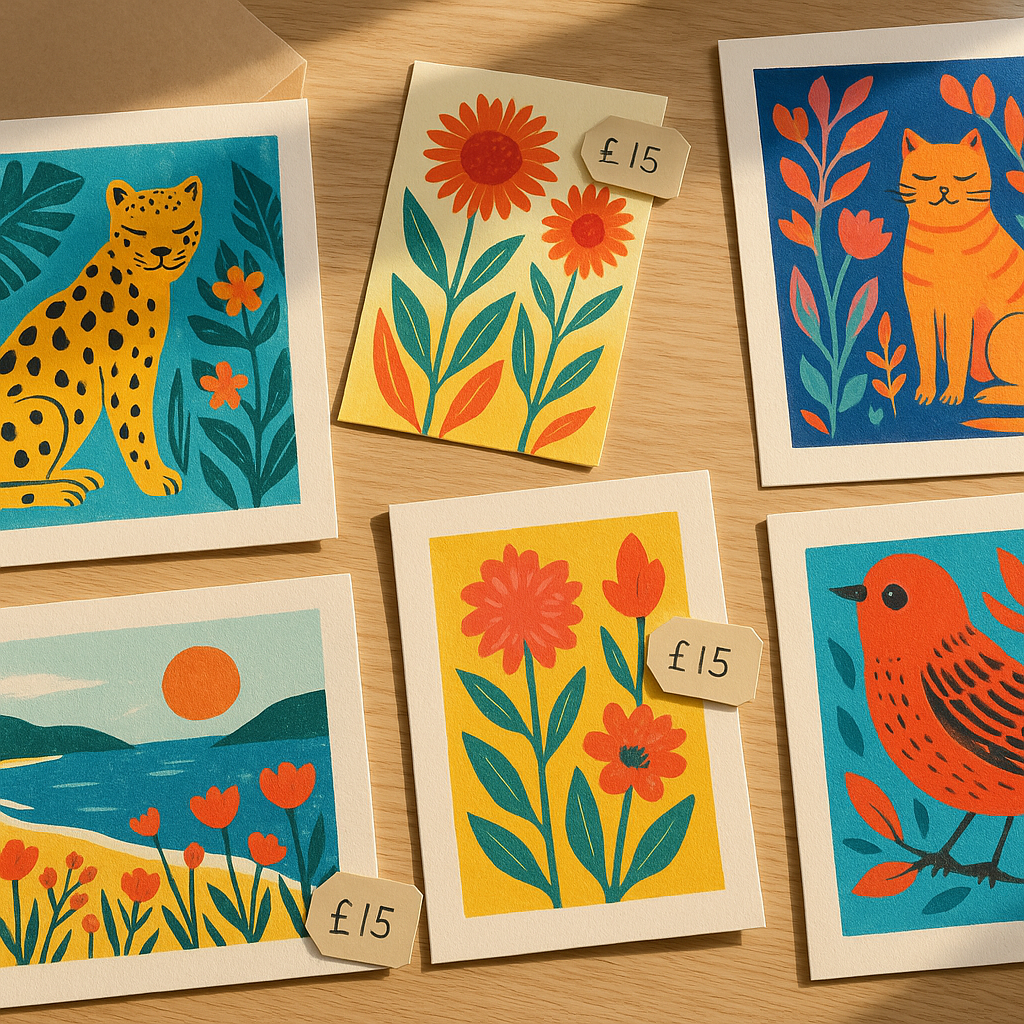
Your style is your brand. If you paint bold, fruity, maximalist pieces, every touchpoint, from your packaging to your profile photo to the font on your shop banner, should feel like an extension of that. Consistency is what turns a casual viewer into a repeat buyer. Choose two or three brand colours that complement your artwork, a simple logo or wordmark, and stick with them everywhere.
Think about what makes your work specific. “I paint nature” is not memorable. “I paint oversized tropical fruit in neon gouache” is. The more specific you get, the more searchable you become, and the more you attract exactly the kind of buyer who will love what you make.
Social Media Tips for Visual Artists in 2026
Instagram and TikTok remain the two most powerful channels for artists who want to grow quickly. Instagram rewards consistent posting and strong aesthetics; TikTok rewards process videos, personality, and storytelling. Both are worth your time, but if you can only focus on one, go where your buyers spend their time. For bold, colourful illustration and print work, Instagram still wins for UK audiences.
Post your process, not just the finished piece. Show the pencil sketch, the ink stage, the colour-mixing session. Audiences love watching art come to life, and it builds the kind of trust that turns followers into buyers. Reels and short-form video consistently outperform static posts across both platforms right now.
One of the more practical challenges any artist faces on social media is link management. You can only put one clickable link in your Instagram bio, which becomes a real problem when you have an Etsy shop, a personal website, a Substack newsletter, and a new print launch all happening at once. UK-based creators are increasingly using dedicated link managers to solve this. LinkVine, a free UK-based link-in-bio tool (available at https://linkvine.uk), is built specifically for this kind of social media juggling act. It lets you create a quick landing page that houses all your important links in one place, so followers can find your shop, your portfolio, and your latest release without any confusion. For influencers and independent artists who need to manage your links across multiple platforms, it is a genuinely handy addition to your toolkit.
Getting Found: Search and Discovery for Artists
On Etsy, the search algorithm rewards keyword-rich titles and tags. Do not call your listing “Floral Print”. Call it “A4 Botanical Floral Art Print, Maximalist Wall Art, Colourful Flowers, UK Artist”. Think about what your ideal buyer actually types into the search bar, and work those phrases into your titles, descriptions, and tags consistently.
On your own website, basic search optimisation matters. Give every image a descriptive filename before uploading it (“lime-green-lemon-art-print.jpg” not “IMG_4472.jpg”). Write page descriptions that mention your location, medium, and style. A blog section, even if you only post occasionally, signals to search engines that your site is active and worth showing to people.
Growing an Audience That Sticks Around
Followers are lovely. An email list is better. Start collecting email addresses from day one, even if you only have fifty people on it. Offer a small incentive: a free desktop wallpaper made from your artwork, a behind-the-scenes PDF, or early access to new prints. Then send a proper newsletter occasionally. Not every week, not a hard sell, just something genuine about what you are making, what you are loving, and what is coming next.
Building a real creative community around your work takes time, but every artist who manages it consistently says the same thing: the audience came when they stopped performing and started sharing what they genuinely love. That is the part that cannot be hacked or automated. It is also the most fun.
As your social channels grow and you start juggling multiple selling platforms, keeping your links organised becomes increasingly important. Artists who use a proper link manager, rather than just updating a single bio link every time something changes, tend to drive more consistent traffic to wherever they most want it. A quick landing page that shows your Etsy shop, your latest print drop, and your newsletter sign-up all at once is a simple upgrade that makes a real difference. Tools like LinkVine sit in this space, offering UK creators a free way to manage your links across social media without the faff of constant bio-swapping.
The path from passionate maker to paid artist is rarely linear. There will be a listing that flopped, a platform that changed its algorithm, a commission that went sideways. That is just part of it. But the artists who keep showing up, keep refining their craft, and keep building their presence consistently are the ones who eventually find themselves genuinely surprised by how well it is all going. That could absolutely be you.
Frequently Asked Questions
What is the best platform to sell art online in the UK?
Etsy is the most popular starting point for UK artists due to its large built-in audience looking for handmade and original work. For print-on-demand without managing stock, Redbubble and Society6 are solid options. For high-value originals, Saatchi Art serves the collector market well.
How do I price my artwork when selling online?
A reliable formula is: (hourly rate x hours worked) + cost of materials + platform fees. For prints, aim for at least a 3x markup on your production costs. Research similar artists at your career stage to sense-check your figures, and avoid chronic underpricing as it can signal lower quality to potential buyers.
Do I need a professional camera to photograph my artwork for selling online?
Not necessarily. A modern mobile phone on its highest resolution setting, combined with good natural light from a large window, produces perfectly acceptable images. The key is consistent, even lighting without shadows, a neutral background, and gentle editing to correct white balance.
How can I grow my following as an artist on social media?
Post your creative process, not just finished pieces. Behind-the-scenes content, speed-paint videos, and colour-mixing reels consistently perform better than static finished artwork posts. Focus on one or two platforms rather than spreading yourself thinly, and post consistently rather than sporadically.
Is it worth starting an email list as an artist selling online?
Yes, from day one. Social media algorithms change constantly, but your email list belongs to you. Even a small list of genuinely interested subscribers will outperform thousands of passive followers when it comes to actual sales, especially for print launches or original artwork releases.
Leave a Reply