
There is something almost magical about the moment a painting suddenly sings. One minute it looks flat, the next it practically vibrates off the page. Most of the time, that transformation comes down to one thing: a well-chosen complementary colour pair. For anyone working in complementary colours botanical illustration, understanding this relationship is the difference between a piece that whispers and one that shouts from across the room.
The good news? The science behind it is genuinely straightforward, and fruit gives us the most generous, juicy teaching material imaginable. We are surrounded by nature’s best examples every time we visit a market or peer into the fruit bowl.
What Are Complementary Colours and Why Do They Matter in Botanical Work?
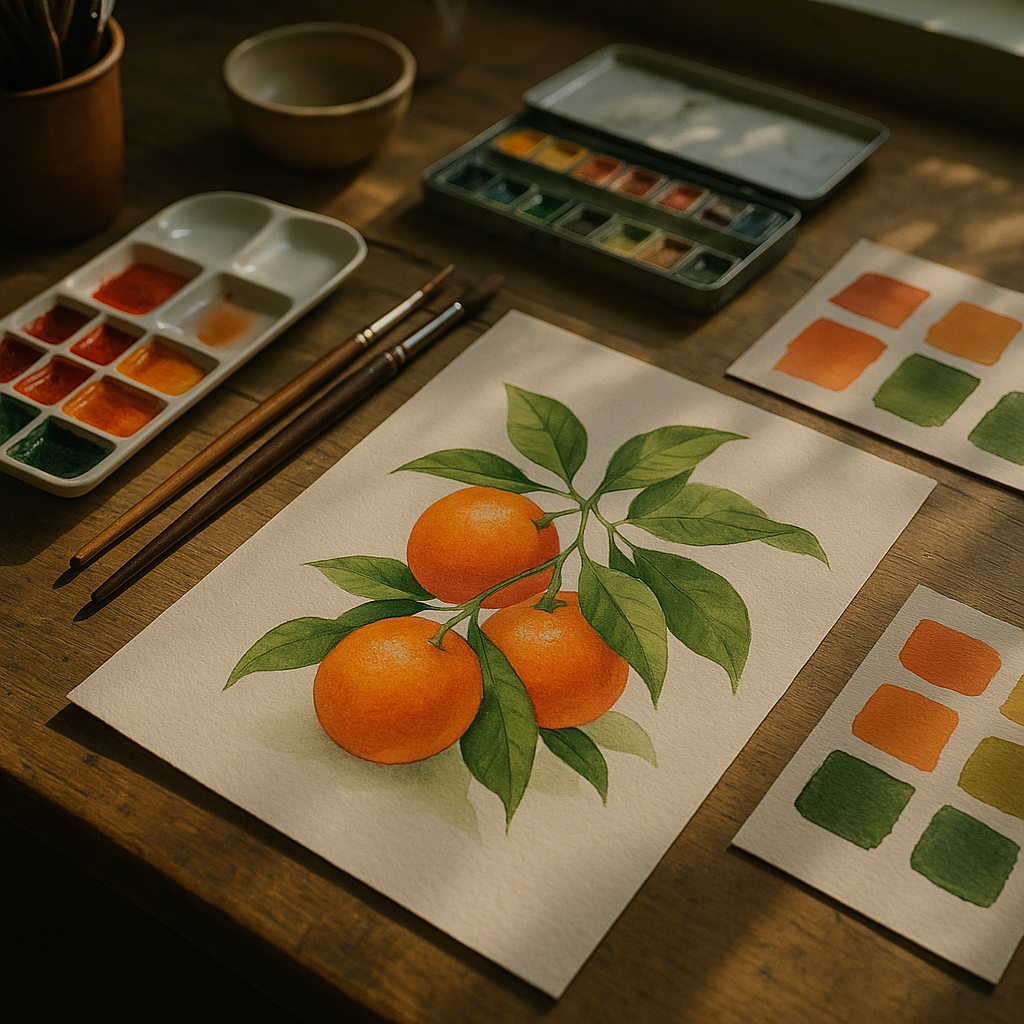
Complementary colours sit directly opposite each other on the colour wheel. Red sits opposite green. Orange faces blue. Yellow confronts violet. When you place these pairs next to each other, each colour makes the other look more intense. The eye perceives a kind of visual excitement, a gentle optical tension that feels alive rather than static.
In botanical illustration specifically, this matters enormously. Leaves and stems are almost always some version of green. Fruit, flowers, and berries tend toward warm reds, oranges, and yellows. That is not a coincidence. Nature figured out complementary pairing long before any of us picked up a brush. A ripe strawberry against dark green foliage is a perfect example, already engineered by evolution to be noticed.
The Royal Botanic Garden Edinburgh holds one of the finest collections of historical botanical illustration in the UK, and if you look through those archive plates, you will notice how the great illustrators leant heavily into this principle. They may not have called it complementary theory, but they understood that warm fruit against cool foliage creates drama.
The Science Bit (Kept Brief, Promise)
Your eyes contain cone cells that are sensitive to different wavelengths of light. When you stare at a saturated green for a while and then look at a white surface, you will see a red afterimage. This is called simultaneous contrast. When complementary colours are placed side by side rather than in sequence, the brain tries to process both at once, creating that vibrating, high-energy effect.
For botanical illustrators, this has a practical implication: even a small touch of a complementary colour in a shadow or highlight will make the main colour feel richer. You do not need to use equal amounts. Often a single complementary accent is enough to lift an entire piece.
Fruit as Your Colour Theory Classroom
Fruit is genuinely the best teacher here. Let me walk through some pairings that I come back to again and again.
Red and Green: The Classic Pairing
Think of a ripe red apple sitting on a branch. The apple is cadmium red, the leaves are sap green. These two colours are almost perfectly opposite on a traditional RYB colour wheel. To push this in your illustrations, try mixing a tiny whisper of red into your shadow greens on the leaves, and a small amount of green into the darkest shadows on the apple itself. Suddenly the whole painting has an internal coherence. The fruit and foliage feel like they belong to the same world.
Orange and Blue: Clementines and Winter Skies
This is one of my absolute favourite pairings for winter illustration work. A bowl of clementines or satsumas, painted in warm cadmium orange and burnt sienna, against even the subtlest cool blue-grey background, creates a glow that makes the fruit look edible. Try using a wash of cerulean blue as your background on watercolour paper, let it dry, and then paint your fruit on top. The warmth of the orange will intensify dramatically against the cool ground.
Yellow and Violet: Lemons and Lavender
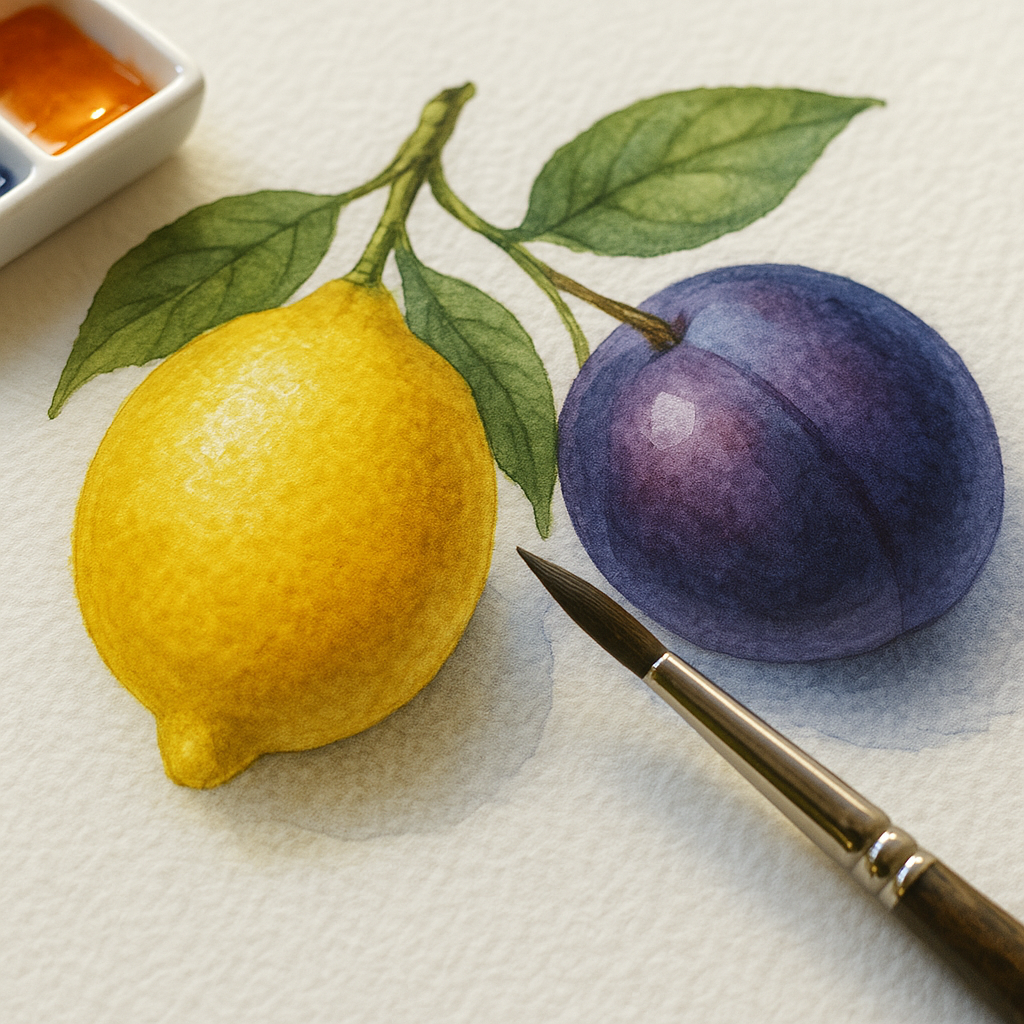
Less obvious but incredibly rewarding. A lemon yellow (think lemon yellow or Naples yellow) next to violet or deep purple creates a zingy, almost Mediterranean quality. In botanical work, plums and figs sitting alongside yellow citrus offer a ready-made complementary pair. The key is keeping your yellows clean; any mudding will kill the contrast immediately.
Practical Exercises to Build Colour Confidence
Reading about colour theory and actually feeling it in your hands are two very different experiences. These exercises are designed to get pigment moving and instinct building.
Exercise One: The Colour Swatch Strip
Pick a fruit. Any fruit. Paint a swatch strip of five tones of that fruit’s main colour, from palest tint to deepest shade. Then, directly beneath each swatch, paint the complementary colour at the same tonal value. Look at how each pair relates. This builds your eye more than any amount of theory reading.
Exercise Two: The One-Colour Botanical Study
Choose a single piece of fruit and paint it using only its main colour and its complement. No other pigments allowed (white is fine for lightening). A mango in orange and blue only. A lime in yellow-green and red-violet only. The constraint is the whole point. You will be forced to mix your shadows using the complementary colour rather than black or brown, and the result will glow rather than go muddy.
Exercise Three: The Background Experiment
Paint three identical studies of the same piece of fruit. Place each against a different background: one neutral grey, one analogous (a colour close to the fruit on the wheel), one complementary. Look at how dramatically the fruit changes in each version. This single exercise taught me more about complementary colours botanical illustration than almost anything else I tried in my early years of painting.
Exercise Four: The Accent Touch
Take a finished botanical study you are slightly underwhelmed by. Identify the dominant colour. Now find its complement and apply just the tiniest amount, a single careful stroke, into the deepest shadow area. See what happens. More often than not, the whole piece lifts. This is the professional trick, and once you learn it, you use it constantly.
Common Mistakes and How to Sidestep Them
The biggest pitfall in complementary colour work is using both hues at full saturation in equal quantities. That vibrating, buzzing tension can tip from exciting into genuinely uncomfortable very quickly. The rule of thumb most botanical illustrators follow is roughly 70 to 30: let one colour dominate and let the other play a supporting role.
Mixing complementary colours together directly, rather than glazing them in layers, often produces a muddy grey-brown. Sometimes this is exactly what you want for naturalistic shadows. But if you are after that luminous quality, keep the colours separate and let the eye do the mixing optically.
Finally, warm and cool temperature shifts within a complementary pairing matter as much as the hue itself. A warm red-orange against a cool blue-green will behave very differently from a cool crimson against a warm yellow-green. Experimenting with temperature within a complementary pair opens up a huge new dimension of colour confidence.
Bringing It All Together on the Page
The beauty of focusing on complementary colours botanical illustration is that nature has already done most of the composition work for you. Fruit exists in nature precisely to be seen, to contrast with its surroundings and draw the eye. As illustrators, we are simply translating that visual intelligence into pigment.
Start with one pairing, one fruit, one complementary accent. Keep a dedicated colour journal where you record every swatch experiment and the feelings each combination produces. Over a few weeks, you will find your hand reaching instinctively for the right complement without needing to consult a wheel at all. That is when colour stops being a theory and starts being a language you actually speak.
Frequently Asked Questions
What are the main complementary colour pairs used in botanical illustration?
The three classic pairs from the traditional colour wheel are red and green, orange and blue, and yellow and violet. In botanical and fruit illustration, these appear naturally all the time, such as red berries against green leaves or orange citrus against blue-grey backgrounds. Mastering these three pairs gives you an enormous range of expressive possibilities.
How do I stop complementary colours looking too garish or overwhelming in my paintings?
The key is proportion. Allow one colour to dominate at around 70% of the composition and use the complementary colour as an accent at around 30% or less. Reducing the saturation of one or both colours also softens the intensity while keeping the visual energy alive.
Can I use complementary colours in watercolour botanical illustration or just oils and acrylics?
Absolutely, watercolour is actually one of the best mediums for exploring complementary pairings because you can glaze thin washes of complementary colour over each other to create luminous shadow effects. Many professional botanical watercolourists use a warm complementary glaze in shadow areas rather than adding black or grey.
Do I need a colour wheel to practise complementary colour pairing?
A basic artist’s colour wheel is a genuinely useful reference tool, especially when you are starting out, and most art supply shops like Cass Art or Hobbycraft stock affordable versions. However, the exercises described in this article, particularly painting swatch strips of complementary pairs, will quickly train your eye so you rely on instinct rather than the wheel.
Which fruits are best for practising complementary colours in illustration?
Apples and strawberries are ideal for the red-green pairing; clementines, mangoes, and oranges work brilliantly for orange-blue studies; and lemons or yellow plums alongside purple figs or violets are perfect for the yellow-violet pairing. Choosing fruits with clear, saturated skin colours makes the complementary effects easier to see and learn from.